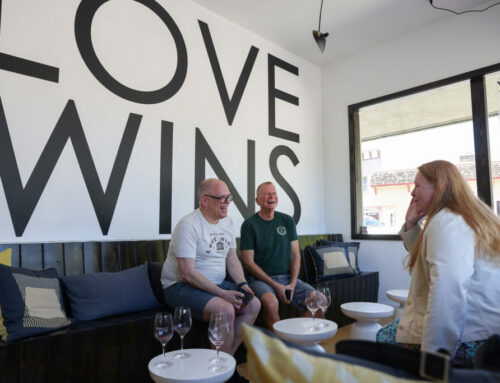
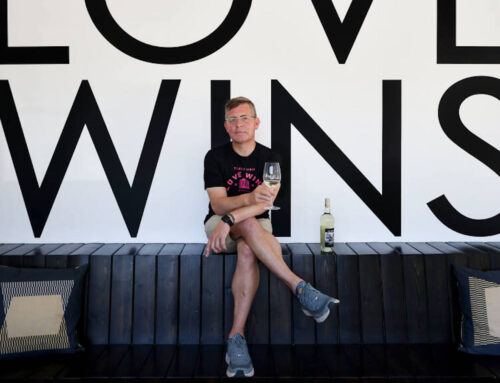
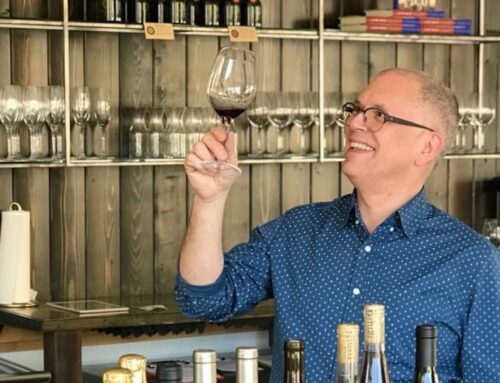
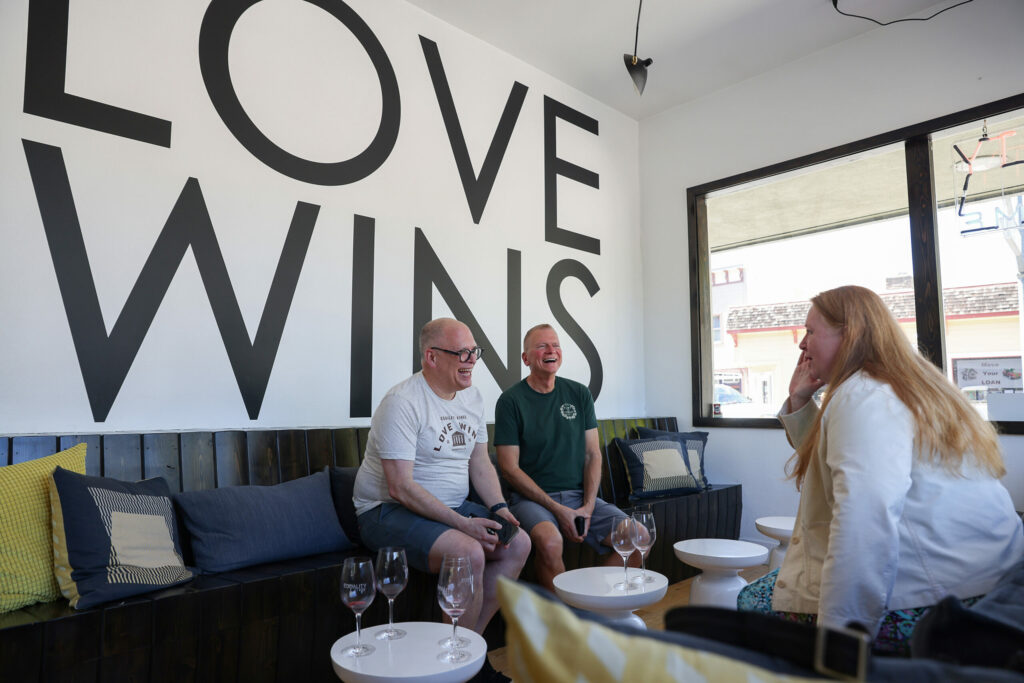
Authenticity counts in relationships and in business, according to Equality Vines co-owners Jim Obergefell and Matt Grove.
The self-proclaimed odd couple — Obergefell is gay; Grove is not — launched their business in Guerneville, a Sonoma County community known to embrace the LGBTQ+ community and stand by those convictions.
Their convictions were tested in March 2022 less than a block away from Equality Vines.
Protesters with bullhorns showed up in front of gay-owned Smart Pizza, which flies a rainbow flag outside. Workers, known as the “pizza brigade,” carved messages of love on their to-go boxes to counter-protest in a town that welcomes visitors and locals with its own sign labeling it a “hate-free” zone.
To this day, Suzy Kuhr said she won’t operate her pizza business in fear and refuses to bring the flag down.
“It’s very accepting in this town,” she said.
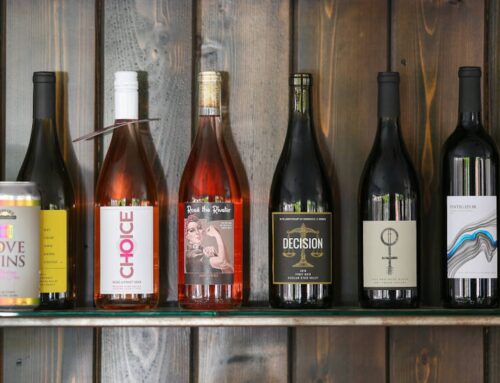
The owners of Equality Vines know how to challenge adversity with love. The tasting room operators and winemakers let the labels on their varietals which range in price from $35 to $65 speak to their target audience and to their beliefs. A cabernet sauvignon labeled “Stonewall” to mark the 1969 New York bar uprising that catapulted the gay rights movement is situated next to a “Love Wins” bubbly. This bottle has a special, personal meaning for Obergefell.
Shortly before he met Grove, Obergefell had just waged a long, hard fight as the lead plaintiff in the U.S. Supreme Court case that legalized same-sex marriage on a national level in 2015.
Obergefell sued when the state of Ohio refused to recognize his marriage to his husband, John Arthur, who died of amyotrophic lateral sclerosis, also known as Lou Gehrig’s disease. Obergefell was unable to be listed as the surviving spouse. He says this motivated him to take his grievance to the U.S. Supreme Court.
The landmark decision made same-sex marriage a “fundamental right” in all states, the first of which to legalize it was Massachusetts in 2004. Obergefell made the personal political.
“I wanted him to die a married man,” Obergefell said of his husband.
A softness came over his face as he further described his husband as witty, sarcastic, funny, smart, even-keeled and genuine.
“John (if alive, years later) would still be getting over the case ending up at the Supreme Court. He would just say, ‘Can’t we all just get along?’”
Six years after meeting, Obergefell and Grove, as business partners, finish each other’s sentences and describe in unison what it takes to attract and retain the LGBTQ+ community as customers of their tasting room on Main Street.
“I think we take pride in our diversity,” Grove said. “Our product is activism in a glass.”
Those convictions have translated into profitability. Equality Vines’ online wine sales for this year are projected to be $100,000, up from a pre-pandemic $12,000 a year.
That success has not been mirrored everywhere.
“All you have to do is look at history. Anytime there’s an advancement of civil rights, you have a backlash,” Obergefell said.
In August, Target reported weak sales from its second quarter and attributed the decline to the retailer facing boycotts and backlash over its Pride Month collection. Chief executives indicated that Target employees faced negative reactions in the wake of the chain’s decision to promote LGBTQ+ causes. Revenue fell 5% to $24.77 billion, according to news reports.
Anheuser-Busch tried a partnership with trans comedian and influencer Dylan Mulvaney in an Instagram video involving the promotion of Bud Light. The partnership sparked a severe backlash, costing its parent company Anheuser-Busch $395 million in lost U.S. sales, according to some reports. In a startling fashion, Budweiser lost its leading status as America’s beer.
The Bud Light brewer may have failed to take into account what its core consumer wanted, unlike Absolut Vodka’s decision in 1981 to place an ad in the Advocate, a national gay magazine. It went on to build an empire of brand loyalty in the gay community.
“The gay community is incredibly loyal. (Companies) don’t need to market exclusively to the gay community, but if they want their brands marketed to them, they need to be authentic. (The community) can sniff out a gimmick,” Grove said.
Yes, there’s the realization that standing up for your convictions may come with risk, sometimes a severe one. But catering and marketing to the gay community is a risk worth taking, Grove insisted.
The line drawn in the sand
Just the notion of risk is what keeps some companies from going all in on promoting to the gay community, according to the Human Rights Campaign, a Washington, D.C.-based LGBTQ+ advocacy group.